




Blog / Service & Maintenance

How to Turn Off StabiliTrak on Chevy Silverado (All Model Years)

StabiliTrak on Chevy Silverado

If you've ever felt your Silverado's engine power dip or the brakes pulse on their own while driving through mud or snow, that's StabiliTrak stepping in. Knowing how to turn off StabiliTrak on a Chevy Silverado, and when it actually makes sense to do so, matters for anyone who drives off-road, tows heavy loads, or just wants more control in specific situations. Our service team works on Silverados from every generation, and this guide breaks down the process for each one.

What Is StabiliTrak on a Chevy Silverado?

StabiliTrak is GM's trademarked electronic stability control system, a name that's been in use since 1996. On a Chevy Silverado, it works alongside the Anti-Lock Braking System (ABS) and Traction Control System (TCS) to keep the truck tracking where you're steering it. The system compares your intended path, based on steering angle, to the truck's actual path. When those two things don't match, it applies braking force to individual wheels to pull the truck back in line.

It relies on wheel speed sensors and a steering angle sensor, plus a yaw sensor that picks up on side-to-side rotation. The system can reduce engine power temporarily to help regain traction, though it doesn't limit power during normal driving. Cruise control will also disengage automatically if TCS or StabiliTrak activates, worth knowing if you're on the highway and hit a slick patch.

Is It Safe to Turn Off StabiliTrak?

Whether it's safe to disable StabiliTrak depends entirely on the driving conditions you're facing. The system helps in situations where your Silverado's actual movement doesn't match your steering input, which covers most of the time you're behind the wheel. But there are specific scenarios where the wheel spin StabiliTrak tries to prevent is actually useful to you.

When Turning It Off Helps (Snow, Mud, Sand, Off-Road)

If you're stuck in deep snow, mud, or sand, StabiliTrak and TCS can work against you by cutting power to spinning wheels when what you need is momentum to rock free. Off-road drivers often turn off traction control and StabiliTrak together to allow more wheel slip, which helps with climbing loose or uneven terrain. Both systems auto-disable in 4WD Low (4LO), since that mode assumes you need maximum wheel articulation.

When You Should Leave It On

Outside those low-traction, off-road scenarios, StabiliTrak should stay active. This holds especially true around Pasadena, Texas, where sudden downpours and slick highways are part of everyday driving. StabiliTrak's ability to correct skids during sudden lane changes or wet-road maneuvers is exactly the kind of protection you want on a rain-soaked freeway.

How to Turn Off StabiliTrak by Model Year

The steps for how to turn off StabiliTrak on a Chevy Silverado have changed across generations, and terminology varies by trim and model year. The table below breaks down what to expect on each platform.


Model Years Button/Menu Location Dash Indicator Reset Method Notes
1999–2006 (GMT800) Varies by trim; often tied to 4WD controls Varies by trim Consult owner's manual No universal button across all trims
2007–2013 (GMT900) TCS/StabiliTrak button on dash "StabiliTrak Off" and "Traction Control Off" Press and hold button 5 seconds Hold time can vary slightly by truck
2014–2018 (K2XX) TCS/StabiliTrak button on dash Single press: TCS Off; hold ~5 sec: both off Press and release, or press and hold Auto-disables in 4LO
2019–2026 (T1XX) TCS/StabiliTrak button on dash Single press: TCS Off; hold ~5 sec: both off Press and hold until lights stay on Auto-disables in 4LO

1999–2006 Silverado (Early StabiliTrak Systems)

Most GMT800-generation Silverados didn't have StabiliTrak at all. Electronic stability control arrived on GM trucks gradually and didn't become standard equipment until the federal phase-in later that decade, so what you'll find on a truck from these years is traction control, often with no dedicated stability control button anywhere on the dash.

If your GMT800 truck does have a stability or traction control switch, placement varies by trim and model year. The owner's manual in your glovebox is the reliable answer here, or bring it by and our technicians will tell you in a minute what your specific truck has.

2007–2013 Silverado (GMT900 Generation)

This generation introduced a more standardized approach. Press and hold the TCS/StabiliTrak button for about five seconds until both the "Traction Control Off" and "StabiliTrak Off" indicators appear on the dash. That's the procedure GM's owner's manuals describe, though the exact hold can feel a touch different from truck to truck.

You might come across suggestions to pull the ABS fuse as a workaround for disabling these systems. We wouldn't recommend that route. Pulling the ABS fuse disables your Anti-Lock Braking System entirely, not just StabiliTrak, and that's a significant safety tradeoff for a shortcut that isn't part of any factory procedure.

2014–2018 Silverado (K2XX Platform)

On K2XX-platform Silverados, the button behavior became more refined. A single press and release of the TCS/StabiliTrak button disables traction control only, which shows up as "Traction Control Off" on the dash or Driver Information Center (DIC). Pressing and holding the button for about 5 seconds disables both TCS and StabiliTrak together, confirmed by both indicators lighting up.

2019–2026 Silverado (T1XX Platform)

The T1XX platform carries forward the same button logic. Press and release to disable traction control alone. Press and hold until both the Traction Control Off and StabiliTrak Off indicators illuminate to disable both. Press and release again to restore both systems. Both turn back on automatically every time you start the truck.

Before going further with any permanent disabling of these systems, it's worth understanding the regulatory side. Permanently disabling StabiliTrak may violate Federal Motor Vehicle Safety Standard FMVSS 126, which requires electronic stability control on vehicles manufactured on or after September 1, 2011 (with full phase-in for altered or multi-stage vehicles by September 1, 2012).

Beyond the compliance angle, a permanently disabled system could complicate matters after an accident or during vehicle inspections, so it's worth discussing with a professional. This is general factual information, not legal advice, so if you're considering a permanent modification, it's worth talking to a professional first. If you have questions about your specific truck, reach out to our team and we can point you in the right direction.

StabiliTrak Off vs. Traction Control Off: Knowing the Difference

A lot of confusion around this topic comes down to not knowing these are two related but distinct systems. TCS focuses on wheel spin: it brakes a spinning wheel or reduces engine power when you're accelerating and one wheel loses grip, common on icy inclines or loose gravel. StabiliTrak, on the other hand, focuses on overall vehicle direction, applying braking to individual wheels when your Silverado's actual path diverges from where you're steering, typically during skids or sharp evasive maneuvers.

A single button press turns off TCS only. Holding that same button turns off both TCS and StabiliTrak together, which is why you'll sometimes see both indicators displayed on the dash at once. Knowing this distinction helps you pick the right level of intervention for whatever driving situation you're in.

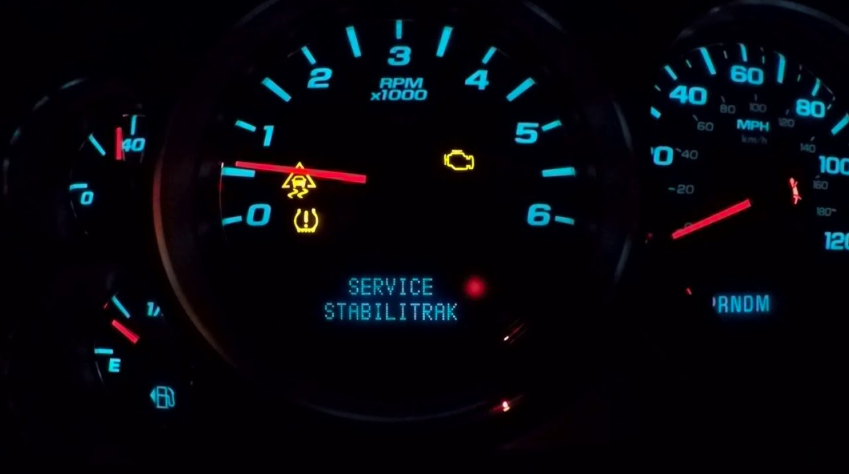
What Triggers the 'Service StabiliTrak' Warning Light

A Service StabiliTrak warning doesn't necessarily mean something's seriously wrong. It means the system found an issue it can't safely work around, and these issues usually trace back to a handful of common culprits.

Common Sensor and Module Issues

Engine misfires are a frequent trigger, particularly in 2009–2013 trucks equipped with Active Fuel Management/Displacement on Demand (AFM/DoD), which are known to develop lifter failures that cause misfires. Dirty or failing wheel speed sensors can send inaccurate data to the system, as can a misaligned or defective steering angle sensor. Low battery or alternator voltage can disrupt the electrical signals these systems depend on, and an ABS module failure will often trigger both the ABS light and the StabiliTrak warning together. Low brake fluid is another straightforward cause worth checking first. One scenario we see often: the light comes on after a battery disconnect or a wheel alignment, usually because the steering angle sensor wasn't recalibrated afterward.

You can generally drive with a StabiliTrak light on for short distances, but the system may be partially or fully disabled while the light is up. Whether it's safe to keep driving depends on what triggered it. If it's paired with an ABS light or the truck feels unstable, get it looked at before continuing to drive.

How to Reset the Service StabiliTrak Light

There are two at-home steps worth trying before heading to a shop. First, disconnect both battery cables for 10 to 15 minutes; this can sometimes clear temporary glitches, though it won't fix underlying mechanical failures. Second, try a steering wheel reset: turn the wheel all the way to the left, then all the way to the right, then restart the engine. This handles steering angle sensor confusion in many minor cases, even without a code reader.

If the light returns after trying these at-home methods, an OBD-II diagnostic scan is the next step, and that's best left to a certified technician. Our factory-trained technicians at Monument Chevrolet can run that scan and, if needed, recalibrate the steering angle sensor.

Turning StabiliTrak Back On

Turning StabiliTrak back on is simple: press and release the same button you used to disable it. The dash indicators for "Traction Control Off" and "StabiliTrak Off" clear once the systems are back online, confirming both are active again.

FAQ

Is it illegal to turn off StabiliTrak? Temporarily disabling StabiliTrak for specific driving conditions isn't illegal, but permanently disabling it may violate FMVSS 126 for vehicles manufactured on or after September 1, 2011, with full phase-in for altered or multi-stage vehicles by September 1, 2012, and it could complicate insurance claims or state inspections.

Will StabiliTrak turn back on by itself? StabiliTrak doesn't re-engage on its own while you're driving, though both systems turn back on automatically every time you restart the truck. Some model years may also restore stability control above a certain speed, so check your owner's manual. It also auto-disables whenever you shift into 4LO.

Visit Monument Chevrolet for Sales and Service in Pasadena

Monument Chevrolet has served Pasadena, Texas for more than 65 years, originally as Timmers Chevrolet, and we remain the only family-owned Chevrolet dealership in the Greater Houston area. Our factory-trained technicians have worked on Silverados across every generation covered in this guide, including early GMT800 trucks and current T1XX-platform models.

Schedule Service or Explore a New Silverado

If your Silverado's Service StabiliTrak light won't clear, or you'd rather have a professional confirm what's triggering it, schedule a service appointment with our team. And if your current truck has you thinking about an upgrade, you can also browse our new Silverado 1500 inventory at our Pasadena location on Pasadena Fwy.

Posted in:

Related Posts

Technician inspecting Chevrolet Equinox engine during service

Why Does My Chevy Equinox Keep Stalling?

Few things rattle you like your Equinox suddenly cutting out at a light or losing power mid-turn. If you're asking why your Chevy Equinox keeps stalling, you're not imagining a fluke. Several Equinox model years have well-documented stalling problems that trace back to identifiable parts once a technician gets a scan tool on the car. If it's happening more than once, we recommend scheduling a diagnostic visit rather than waiting to see if it resolves on its own. Chevy Equinox Stalling: A Common but Fixable Problem Stalling usually shows up in a pattern: idling at a stop light, turning a corner, or easing into light acceleration. That pattern actually helps, since it gives technicians a starting point instead of a mystery. Owners dealing with a Chevy Equinox that shuts off while idling are almost always describing one of a handful of known mechanical culprits, not a random defect. Treat stalling as a symptom pointing to a specific system rather than a standalone problem, and the diagnosis gets a lot easier. Eco Mode auto stop-start isn't stalling, and it helps to separate the two right away. This is a normal, manufacturer-designed feature built into certain Equinox trims that shuts the engine off briefly at complete stops to save fuel, then restarts it automatically when you lift off the brake. If your engine restarts smoothly and predictably, that's Eco Mode doing its job. Actual stalling is unpredictable, doesn't restart on its own, and often comes with warning lights or rough running beforehand. Top Causes of Chevy Equinox Stalling Four systems account for the vast majority of Equinox stalling complaints: fuel delivery, ignition, sensors and air intake, and idle control. These systems work together to keep combustion balanced, so a failure in one often mimics the symptoms of another. That overlap is exactly why guesswork rarely solves the problem for good. Cause Common Symptoms Typical Trigger Difficulty to Diagnose Repair Urgency Fuel System Sluggish restart, sputtering before shutoff Driving or after refueling Professional (pump failures often skip the check engine light) High Ignition System Misfires, hard starting, dropping fuel economy Driving, worsens over weeks Professional Medium Air Intake/Sensors Hesitation right after startup, rough idle Idle or low speed Professional (needs scan tool) Medium Idle Control/Vacuum Rough idle, stalling only at stops Stopping or idling Professional Medium Software/Eco Mode Smooth, predictable engine shutoff and restart Complete stops DIY (just confirm restart is smooth) None (normal feature) Fuel System Problems: Filters, Pumps, and Injectors Bad gas, water contamination, or just running low on fuel can trigger near-immediate stalling. A clogged fuel filter or a failing fuel pump restricts fuel flow to the engine, starving it at the worst possible moments. The check engine light frequently stays off during early fuel pump failure, which makes this one harder to catch than you'd expect. One basic thing you can listen for is a faint hum from the fuel pump when you turn the key to "on" before starting; silence there can be a clue. If your Equinox stalls and restarting feels sluggish or requires multiple tries, fuel delivery should be high on your suspect list. Ignition System Issues: Spark Plugs, Coils, and Wiring Worn spark plugs and failing ignition coils typically don't cause instant stalling; they cause misfires first. You'll usually notice hard starting, dropping fuel economy, and sputtering or jerking at speed before the engine actually stalls at a stop. Loose or corroded electrical connections, a weak battery, or a faulty alternator can compound the issue. If your Equinox has been running rough for weeks before stalling started, ignition components are a likely contributor. Sensor and Air Intake Malfunctions: MAF, MAP, and Throttle Body The MAF sensor, positioned between the air filter and intake manifold, feeds the engine computer critical data about incoming air. When it's dirty or failing, it sends bad readings that throw off the air-fuel mixture. On the 2.4L engine specifically, idle hesitation and stalling frequently trace back to a faulty camshaft position sensor or a dirty throttle body. Stalling paired with hesitation right after startup often points here rather than to the fuel tank. Idle Control Issues and Vacuum Leaks A failing idle air control valve, a malfunctioning idle actuator, or a clogged or defective EGR valve can all cause rough idling and stalling specifically when the vehicle comes to a stop. Actuator solenoid issues on the 2012 Equinox have been linked to stalls when accelerating from a stop, backing up, or simply idling at a light. If stalling only happens at low speeds or standstill, idle control is worth checking first. Because these systems interact, a scan-tool diagnostic at a certified service center is really the only reliable way to confirm which one is actually at fault. Guessing based on symptoms alone can send you chasing the wrong part. Matching Your Symptoms to the Likely Cause Where and when your Equinox stalls tells you a lot. Use your specific scenario below to narrow down what's likely happening under the hood. Stalling While Idling or at Stop Lights A Chevy Equinox that shuts off while idling, especially paired with rough or uneven engine sound beforehand, usually points to throttle body buildup, idle control problems, or a failing camshaft position sensor. Owners of the 2011 Equinox have reported resolving this exact issue by having the throttle body cleaned or replaced and the idle relearned afterward. If you're dealing with a 2013 Equinox that idles rough and stalls, this is often the same root cause. Shutting Off While Driving or Turning If your Chevy Equinox keeps shutting off while driving, this pattern more often points to fuel delivery problems than idle issues. Fuel delivery failures, including the type addressed by GM's 2023 fuel pump module recall, have caused some Equinox models to stall unexpectedly while driving. This scenario is more urgent since losing power while moving affects your ability to steer and brake safely, something drivers navigating stop-and-go traffic on the Pasadena Fwy should take seriously. Shaking or Jerking When Stopped Reports of the Equinox shaking when stopped frequently trace back to 2012 model-year complaints about rough idle, stalling, and power loss specifically at lights. Ignition coil wear, a struggling idle actuator, or throttle body buildup are the usual suspects. If your Equinox is doing this consistently, don't ignore stalling when stopping, since it tends to worsen over time rather than resolve itself. Is This a Known Issue? Equinox Model Years to Watch Stalling isn't evenly distributed across every Equinox model year. Some years carry a documented history worth knowing about. Model Years with Reported Stalling Problems The 2010 model year alone has accumulated 780 NHTSA complaints and three recalls as of 2025, with excessive oil consumption and a timing chain issue linked to rough idle and stalling. The 2011 model year shares similar engine reliability issues. The 2012 model year continues to generate reports of severe stalling and power loss. More broadly, the 2010 through 2017 range shows a pattern of engine reliability complaints involving oil consumption, timing chain failure, and stalling. Worth noting: the 2018 model year's 336 complaints and five recalls relate mainly to a brake booster and vacuum pump issue, not stalling, so don't assume every complaint from that year applies here. The 2020 through 2023 range has generated numerous NHTSA complaints specifically about fuel pump performance. Recalls and Technical Service Bulletins GM issued a recall for certain 2021 to 2022 Equinox and 2022 GMC Terrain vehicles because the fuel pump module may not consistently supply enough fuel, which can cause the engine to stall. This recall affected 23,323 units, and dealers replace the fuel pump module free of charge. Owner notifications began in March 2023, with final owner letters mailed by May 17, 2023, under GM recall number N222372310 and NHTSA campaign 23V013000. If your Equinox falls into these years, check your VIN against NHTSA's official recall list to see if you're covered. What to Do When Your Equinox Stalls Whether you're stalled at a light or on the Pasadena Fwy during rush hour, how you respond matters for your safety and for helping a technician pinpoint the cause. Immediate Safety Steps If Your Equinox Stalls While Driving Turn on your hazard lights right away Shift into Neutral and coast toward the shoulder, staying as far from traffic as possible On a highway, aim specifically for the right shoulder If you can't reach the shoulder and are stuck in a travel lane, stay inside the vehicle and call 911, never attempt to cross a highway on foot Once safely on the shoulder, exit only through the passenger door Remember that stalling cuts power steering and power brakes, so both steering and stopping will feel noticeably harder Simple Checks Before Calling a Mechanic Before your appointment, a few basic checks can help. Look at whether your check engine light is on and, if you have access to a code reader, note any OBD-II codes. Check your battery terminals for corrosion, since voltage below 12.6V can point to a weak battery. You can also visually inspect the fuel filter, spark plugs, and air filter for obvious wear, though we'd stop short of attempting repairs on fuel, ignition, or electrical components yourself. These systems require proper diagnostic equipment to service safely and correctly. When to Bring Your Equinox to the Experts Smoke, unusual noises, overheating, or just a nagging feeling that something's off: any of these mean it's time to stop troubleshooting and get professional eyes on the vehicle. Stalling that occurs while slowing down or stopping is particularly unsafe to keep driving on and shouldn't wait. When you bring your Equinox to a shop, expect a test drive, a technician listening closely at idle, and a scan-tool code reading. That's the same multi-step process we follow, since stalling so often involves overlapping systems that only a full diagnostic can sort out accurately. Visit Monument Chevrolet for Reliable Repairs, Trade-Ins, and New Vehicles Monument Chevrolet has served the Pasadena, TX community and the Greater Houston area for more than 50 years as a family-owned dealership focused on giving you a straight answer instead of a shrug. Our Pasadena service center is staffed with factory-trained technicians who work exclusively with genuine OEM Chevy parts, and we make the process convenient with 24-hour drop-off and pickup along with shuttle service and on-site Enterprise Rentals while your vehicle is with us. Ready to Get Started? If your Equinox has reached a point where repairs no longer make sense, or you're simply ready for something newer, our team can walk you through a trade-in valuation and show you what's available across our new and used inventory. Reach out through our contact form to get started, or browse our new and used Chevrolet inventory to see your options. We're located at 3940 Pasadena Fwy, Pasadena, TX 77503, and you can also reach us at (713) 581-8123.